
Table of Contents
- Moisturizing Psoriasis vs Rejuvenating Skin Cells: What Is the Difference?
- Why Psoriasis Creates a Damaged Skin Barrier
- How to Repair Skin Barrier with Psoriasis: Hydration First
- Benefits of Using Tallow for Psoriasis Relief and Cell Turnover
- Natural Anti-Inflammatory Skincare for Psoriasis: What to Look For
- How to Layer Moisturizers and Active Ingredients for Psoriasis Management
- Conclusion: Build a Routine That Supports Both Hydration and Repair
- Frequently Asked Questions
Last Updated: September 6, 2026
Moisturizing Psoriasis vs Rejuvenating Skin Cells: What Is the Difference?
Psoriasis is a chronic autoimmune condition that accelerates skin cell turnover, causing the buildup of thick, silvery psoriatic plaques. This rapid epidermal turnover, sometimes completing in days rather than weeks, leaves the skin barrier dysfunctional and unable to retain moisture. When considering provides deep moisturization vs rejuvenates skin cells for psoriasis management, it helps to understand that these are not competing goals but two distinct biological processes that work together. This guide breaks down what each approach actually does so you can build a routine that supports both.
Most conventional guides focus on symptom suppression, but the deeper question is why the skin barrier fails in the first place. Moisturization addresses the symptom of dryness by trapping water in the stratum corneum, while cell rejuvenation targets the underlying dysfunction of rapid, incomplete keratinocyte proliferation. Below, we will show you exactly how to layer these strategies for lasting plaque clearance and relief.
Why Psoriasis Creates a Damaged Skin Barrier
The skin barrier in psoriasis is not merely dry; it is structurally and biochemically compromised. In normal skin, keratinocytes take roughly 28-30 days to mature, migrate to the surface, and form the stratum corneum's protective lipid matrix. In psoriatic lesions, this process is accelerated to just 3-5 days (peer-reviewed research). This hyperproliferation, driven by T-cell mediated inflammation, specifically Th17 and Th22 cells releasing interleukin-17 (IL-17) and interleukin-22 (IL-22), forces immature keratinocytes to the surface before they can synthesize the necessary lipids.
The result is a stratum corneum that is both thicker (acanthotic) yet paradoxically weaker. The corneocytes are smaller and less organized, and the intercellular lipid lamellae are deficient in key components, particularly ceramides. In healthy skin, ceramides make up roughly 50% of the lipid content (PubMed). In psoriatic plaques, the ratio of ceramides is altered, with a notable decrease in ceramide 1 (acylceramide) and an increase in shorter-chain ceramides. This imbalance creates a 'leaky' barrier where transepidermal water loss (TEWL) can be 2 to 3 times higher than in unaffected skin.
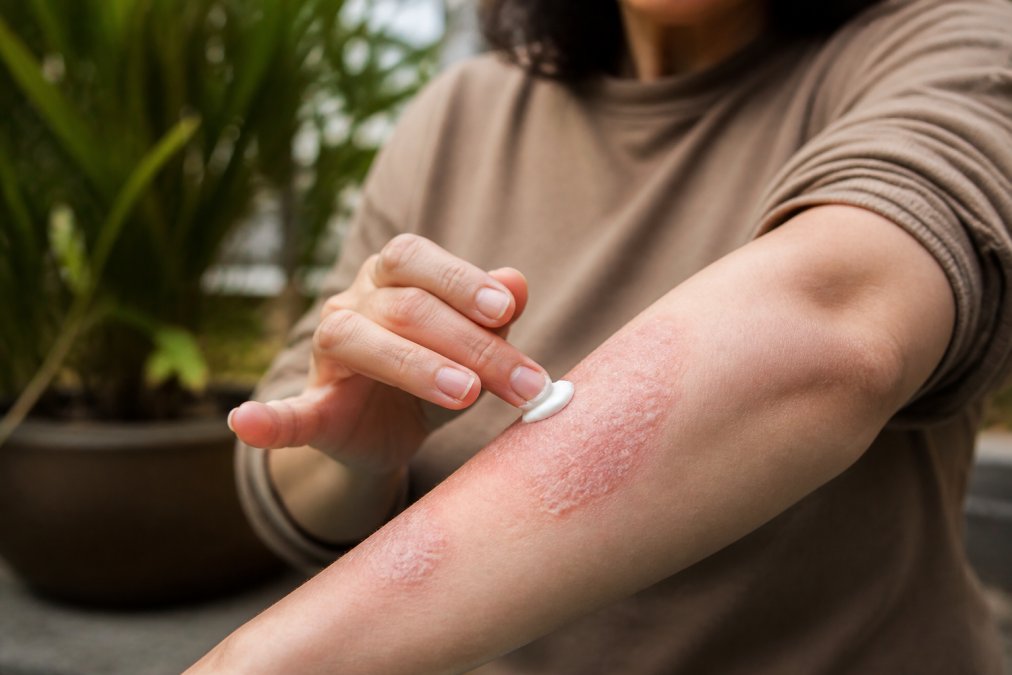
This rapid turnover also depletes natural moisturizing factor (NMF), a mixture of amino acids, lactic acid, and urea derived from filaggrin breakdown. Without adequate NMF, the stratum corneum cannot hold onto water even when humidity is high. The deficiency is compounded by an overabundance of proteases, which prematurely break down the already fragile lipid envelope. Understanding this pathophysiology explains why simple emollients fail: they provide occlusion but not the specific lipid replacement or protease regulation needed to restore normal barrier architecture.
The Role of Transepidermal Water Loss
Transepidermal water loss is the measurable rate at which water passes through the skin to the atmosphere, typically measured in g/m²/h. In psoriatic plaques, TEWL is significantly elevated, often exceeding 20-30 g/m²/h compared to 5-10 g/m²/h in healthy skin, because the barrier is incomplete (peer-reviewed research). This water loss triggers a cascade: the skin becomes dehydrated, which activates keratinocyte stress responses and further upregulates inflammatory cytokines. The dryness also causes micro-fissures that allow irritants and microbes to penetrate, perpetuating the Koebner phenomenon where new lesions form at sites of injury. Breaking this cycle requires a two-pronged approach: reducing the inflammatory drive that accelerates cell turnover, and simultaneously providing the lipid building blocks (ceramides, cholesterol, free fatty acids) that the immature keratinocytes failed to produce.
How to Repair Skin Barrier with Psoriasis: Hydration First
Hydration is the foundation of any psoriasis management plan. Emollients and occlusives fill the gaps between skin cells and create a physical seal that stops transepidermal water loss. Without this step, active ingredients cannot work effectively because the skin is too compromised to absorb them. Think of hydration as preparing the ground before planting seeds: the skin must be pliable and receptive before treatment can penetrate.
The hierarchy of symptom management starts with moisture retention. Ingredients like ceramides, which are the building blocks of the skin barrier, and urea, which is both a humectant and a gentle keratolytic agent, help restore the stratum corneum's integrity. Salicylic acid also plays a role here by softening and lifting scales so that hydrating ingredients can reach the living layers beneath. A common mistake is reaching for heavy creams that sit on top of the skin without addressing the lipid deficit underneath.
Benefits of Using Tallow for Psoriasis Relief and Cell Turnover
Beef tallow is one of the few natural substances that closely mimics the oils your skin produces on its own. This bioidentical composition is why tallow is so effective for managing scaling and desquamation: it delivers the exact fatty acids and vitamins the skin barrier is missing. For the benefits of using tallow for psoriasis relief, the key is its richness in vitamins A, D, E, and K, along with linoleic acid, which supports skin elasticity and helps regulate the inflammatory response that drives rapid cell turnover.
The benefits of using tallow for psoriasis relief extend beyond simple moisturization. Tallow contains anti-inflammatory and anti-fungal properties. Because tallow is so similar to human sebum, it absorbs readily rather than sitting on the surface, which means it delivers nutrients directly to the basal layer where cell cycle regulation actually happens.
IT'S THE BALM CO.'s Unscented Tallow Balm is our most straightforward formulation for this purpose. At $34.00 for a 4oz jar, it contains only two ingredients: 100% grass-fed and grass-finished tallow and calendula-infused jojoba oil. This simplicity makes it ideal for highly reactive skin that cannot tolerate essential oils or synthetic additives. A small amount goes a long way, and it is specifically formulated to support skin hydration and reduce the appearance of psoriatic plaques without clogging pores.

Natural Anti-Inflammatory Skincare for Psoriasis: What to Look For
Natural anti-inflammatory skincare for psoriasis should prioritize ingredients that interrupt the inflammatory cascade without disrupting the skin's microbiome. Calendula, for example, is a well-documented botanical with anti-inflammatory properties that soothe irritated skin.
For those who can tolerate essential oils, specific varieties offer targeted benefits. What most guides miss is that the quality and purity of these oils matter enormously; therapeutic efficacy depends on using certified pure, tested-grade oils rather than fragrance-grade substitutes.
| Ingredient | Primary Role | Best Used For |
|---|---|---|
| Tallow | Lipid replacement, barrier repair | Deep moisturization, reducing scaling |
| Calendula | Anti-inflammatory, antimicrobial | Soothing erythema and irritated plaques |
| Urea | Humectant, keratolytic | Softening thick scales, boosting hydration |
| Salicylic Acid | Exfoliant | Lifting psoriatic plaques for treatment penetration |
| Ceramides | Barrier lipid replacement | Reducing transepidermal water loss |
How to Layer Moisturizers and Active Ingredients for Psoriasis Management
The order of application is not a cosmetic preference; it is a pharmacokinetic necessity. The stratum corneum acts as a reservoir, and the penetration of any active ingredient depends on its formulation and the barrier's integrity. A practical, evidence-informed layering strategy follows a simple hierarchy: thin to thick, water-based to oil-based, and active to supportive.
A Decision Matrix for Flare Severity
Most guides offer a single routine, but psoriasis is dynamic. The ratio of moisturization to active treatment should shift based on the clinical presentation. Use this matrix to adjust your approach:
| Flare Severity | Clinical Signs | Primary Goal | Recommended Layer Order |
|---|---|---|---|
| Mild / Maintenance | Minimal scaling, no erythema, skin feels tight | Barrier preservation | 1. Light humectant (glycerin or hyaluronic acid serum) 2. Ceramide-rich moisturizer 3. Thin occlusive (squalane or lightweight balm) |
| Moderate / Active Plaque | Visible silvery scale, mild redness, pruritus | Scale removal + barrier repair | 1. Keratolytic (salicylic acid 2-5% or urea 10%) on plaques only 2. Prescribed topical corticosteroid or vitamin D analog 3. Full-coverage lipid-rich balm (tallow-based) |
| Severe / Thick Plaque | Significant hyperkeratosis, fissuring, bleeding | Desquamation + anti-inflammatory action | 1. Keratolytic under occlusion (e.g., salicylic acid ointment covered with plastic wrap for 1-2 hours) 2. High-potency topical steroid (as prescribed) 3. Thick occlusive balm applied generously, possibly with cotton gloves overnight |
The 15-Minute Rule for Actives
Topical corticosteroids and vitamin D analogs (like calcipotriene) require a dry, clean surface for optimal absorption. Applying a heavy moisturizer immediately before these actives can dilute them or create a barrier that blocks penetration. The standard practice is to apply the active first, wait 15-20 minutes for absorption, and then apply the moisturizer. This 'soak and seal' approach ensures the medication reaches the viable epidermis before the occlusive locks it in.
Ingredient-Specific Pairing: What Works with What
Not all moisturizers are neutral carriers. Some ingredients actively interfere with or enhance actives:
- Salicylic acid is lipophilic and can enhance the penetration of topical corticosteroids. However, it should not be applied simultaneously with calcipotriene, as it inactivates the vitamin D analog. Use salicylic acid in the morning and calcipotriene at night.
- Urea at concentrations above 10% is keratolytic and can increase the absorption of other drugs. This is beneficial for steroids but can increase the risk of local side effects like skin atrophy if used chronically with potent steroids.
- Ceramides are compatible with all actives and do not affect penetration. They are best applied after actives to restore the lipid matrix.
- Tallow-based balms are highly occlusive. They are excellent as a final sealing layer but should not be applied before a water-based active, as they will prevent its absorption.
A Practical Nighttime Routine for Moderate Flares
- Cleanse with a lipid-free, soap-free cleanser. Pat skin dry, do not rub.
- Apply keratolytic (e.g., 5% salicylic acid ointment) to the thickest plaques. Allow 10 minutes.
- Apply prescribed active (e.g., triamcinolone 0.1% cream or calcipotriene) to the same plaques. Allow 15 minutes.
- Apply a ceramide-rich lotion to the entire affected area to begin barrier repair.
- Seal with a tallow balm over the plaques. The high oleic acid content in tallow provides rapid occlusion and delivers linoleic acid, which is a precursor for ceramide synthesis.
:::takeaway The most effective approach to psoriasis management is not a single product but a dynamic layering system that adjusts to flare severity. By understanding which ingredients complement or interfere with each other, patients can move beyond generic advice and build a routine that addresses both the symptom (dryness) and the mechanism (rapid cell turnover).
Conclusion: Build a Routine That Supports Both Hydration and Repair
Psoriasis management requires understanding that hydration and cell rejuvenation are not either-or choices. A damaged barrier cannot heal without moisture, and rapid cell turnover cannot slow without the nutrients that regulate it. The most effective routines address both simultaneously.
At IT'S THE BALM CO., our handcrafted tallow balms are formulated to deliver deep moisturization while supporting healthy skin cell function. The Soothe Tallow Balm, at $35.00, combines grass-fed tallow with a blend of essential oils. For those with the most sensitive skin, the Whipped Unscented Tallow Balm at $40.00 offers the same barrier-repairing benefits in a lighter, velvety texture without any added fragrance.


Get started with IT'S THE BALM CO. and give your skin the lipid-rich nourishment it needs to rebuild a healthy barrier and calm the cycle of rapid cell turnover that drives psoriasis flares.
Frequently Asked Questions
Is it better to moisturize psoriasis or let it dry out?
It is always better to moisturize psoriasis. Dry skin increases transepidermal water loss, which worsens scaling, cracking, and pruritus. A compromised skin barrier allows more irritants in and lets moisture out. Regular application of an emollient or tallow balm helps trap water in the stratum corneum, reducing the appearance of psoriatic plaques and supporting the skin's natural repair process. Letting plaques dry out typically leads to more intense itching and thicker scale buildup.
Why is deep moisturization essential for psoriasis plaques?
Psoriasis plaques form because the skin barrier is compromised and epidermal turnover is accelerated. Deep moisturization is essential because it reduces transepidermal water loss, softens thick scale, and improves the penetration of active ingredients. A product like our Unscented Tallow Balm, made from grass-fed tallow, provides lipids similar to human sebum. These help restore the stratum corneum's structure.
How does skin cell rejuvenation differ from simple hydration?
Hydration adds water to the stratum corneum, which softens scale and soothes tightness. Skin cell rejuvenation addresses the underlying issue of keratinocyte proliferation, the rapid cell turnover that creates psoriatic plaques. Ingredients like vitamin A and essential fatty acids, found in grass-fed tallow, support the skin's ability to regulate its cell cycle. While moisturizers manage the symptom of dryness, rejuvenating ingredients help normalize the skin's renewal process.
Can natural ingredients effectively rejuvenate skin cells affected by psoriasis?
Yes, certain natural ingredients can support healthier skin cell function. Grass-fed tallow contains vitamins A, D, E, and K. These nutrients, combined with the anti-inflammatory properties of tallow, create an environment where the skin can slow its excessive cell turnover and begin producing healthier cells.